Issued by the Catholic Center for Studies and Media - Jordan. Editor-in-chief Fr. Rif'at Bader - موقع أبونا abouna.org

“The Togetherness”
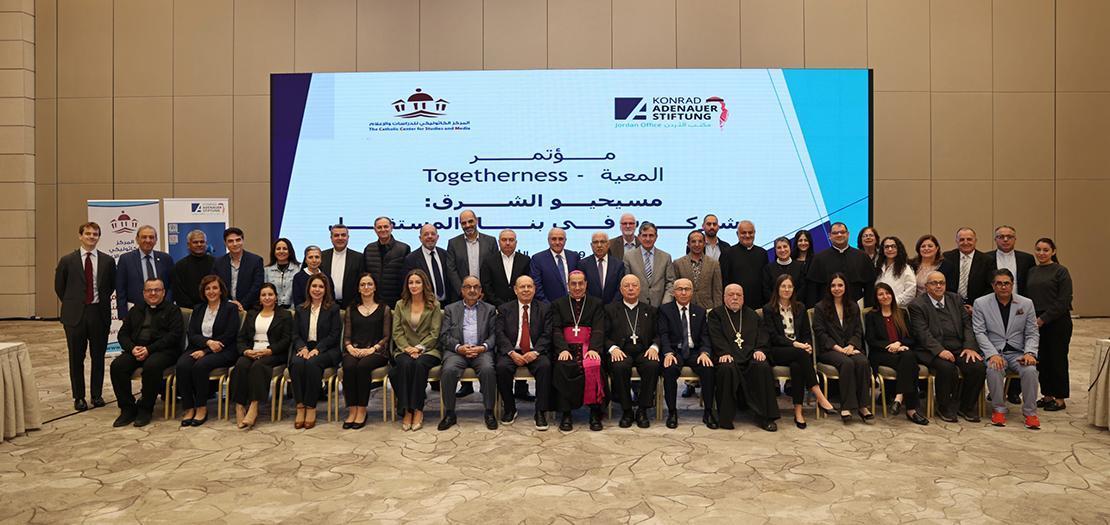
In moments of grief, the significance of words becomes clearer than at any other time. After the martyrdom of the beloved nine Jordanians at the Church of Saint George in Hmoud, talking about terrorism and national unity has no longer become theoretical, but rather an expression of shared pain and responsibility.
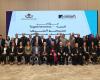
From this anguish came the message of the conference, namely “Togetherness” and “Christians of the East as Co-Builders of the Future” which was held under the noble patronage of Prime Minister Dr. Jafar Hassan, who was deputized by Minister of Tourism and Antiquities Dr. Imad Hijazin. The conference was organized by the Catholic Center for Studies and Media and Konrad Adenauer Stiftung and its Amman office, with the participation of Thomas Rachel, the German Federal Government Commissioner for Religious Freedom or Belief and a Member of the German Bundestag, in addition to a number of experts from Jordan, Egypt, Syria, Iraq, Lebanon, and Palestine.
I started my welcoming address, in my capacity as director of the Catholic Center for Studies and Media, by calling for a minute of silence and prayer for the souls of the martyrs, remembering them by name. This affirmed that the martyrs are not numbers but people with events, families, and dreams. This remembrance carried a meaning beyond mourning, namely that safeguarding of human dignity begins with recognizing one another as an individual, and that the pain that inflicted the martyrs’ families affected the entire nation.
From this premise “the Togetherness” emerged as more than merely a word or a slogan. It means that no one is left alone in the face of grief, fear, or extremism, and that we admit that the future of Christians and Muslims in our homelands is not a separate matter for one group or another, but a responsibility shared by all. We cannot think of Christians separately, or of Muslims as an isolated island, since the future belongs to all of us, and its responsibility rests on all of us.
The word “Togetherness” coveys the meaning of genuine partnership, namely that we listen to one another, cooperate in facing challenges, protect human dignity, and reject turning religious or cultural difference into a cause for schism. At the same time, it does not imply brushing aside the distinctiveness of any community or settling for unreal common living. The Jordanian people as a whole have expressed their rejection of the word “common living” which many used to denote good relations. New terms have emerged to highlight that every component should have its presence and contribution, within a homeland that has room for everyone, under a wise leadership recognized as such across the world.
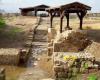
This meaning has taken on special importance in Jordan, a country preparing to commemorate the 2,000th anniversary of the Baptism of Lord Jesus Christ in the waters of the Jordan River. I recalled His Majesty King Abdullah II’s summary of the Jordanian narrative in its capacity as the narrative of a nation, as His Majesty said on this 80th anniversary of Independence Day: "Jordan has never been a mere footnote in human history. Rather, it is a cradle of civilizations, and a land of harmony. Upon the bank of its river, Jesus Christ was baptized, and it was home to the Companions and those who followed in their footsteps." It is a historical image that reminds us that Jordan’s diversity is not incidental to its identity, but part of its very makeup.
From this premise, “The Togetherness” was chosen as the title of the conference and of the future of the countries taking part. The challenges facing societies, from extremism and violence to polarization and weakened trust, cannot be addressed by one group alone, as security measures alone are not adequate to confront them. Security is a necessity, but sustainable protection also requires intellectual, educational, and cultural work that enhances acceptance of others, serves as a bulwark for generations against hate speech, and makes citizenship a shared responsibility for everyone.
“The Togetherness” is a call to build this future together, namely Christians and Muslims, religious and civil institutions, in addition to present and future generations. It is a call for partnership to move from words spoken on occasions to practical steps in education, media, and public service, and for every person to have a role in protecting and enhancing the national fabric.
In Amman, between the pain of loss and the clinging to hope, and even though the conference was organized months before the tragedy at the Hmoud Church, “The Togetherness” seemed like a magic word for the days ahead. This is not because it offers a ready-made solution, but because it confronts us with the most important question, namely how do we create a future in which no one survives alone, but rather all rise together? I am confident that in the near future we will hold intensive intellectual workshops to formulate a comprehensive strategy. It will examine, in a particularly important and urgent way how to combat the seeds of extremism that may dwell in some minds of our Jordanian and Arab youth. We have a great duty to confront them and address their causes, so that we may jointly cooperate, in the spirit of “togetherness” to cleanse society of this scourge which, when it strikes, it causes great harm and kills innocent souls.
Let us get to work, in the fruitful, humane spirit of “Togetherness”…